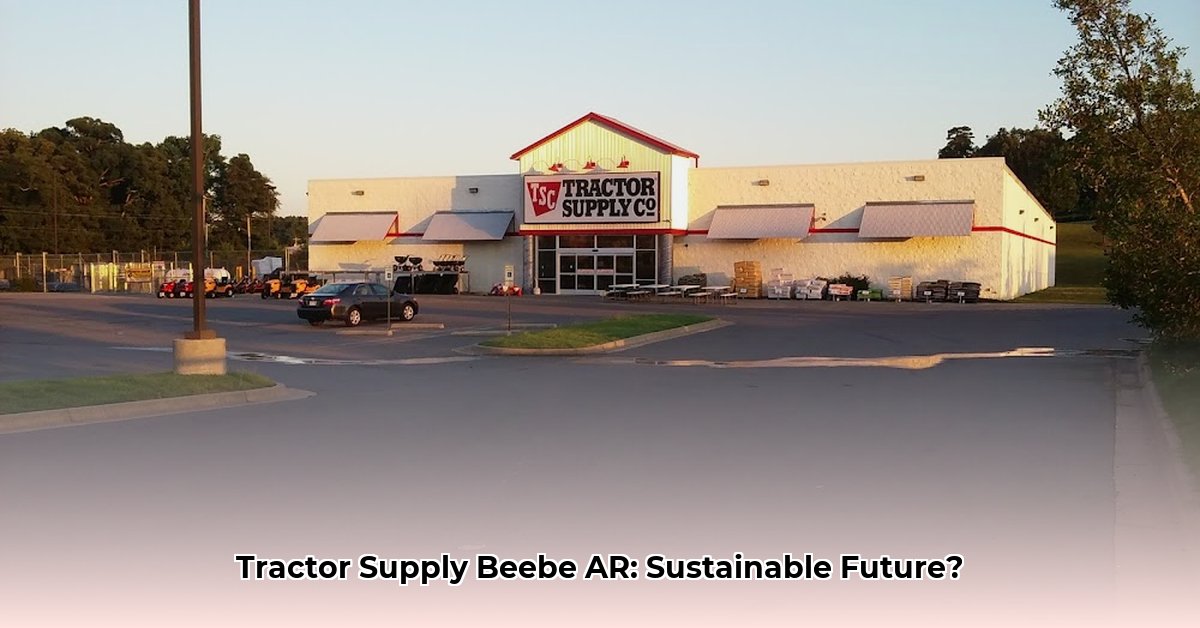
Tractor Supply Beebe AR: A Rural Retail Landscape and its Sustainability Challenges
Tractor Supply Company (TSC) in Beebe, Arkansas, serves as a vital resource for the local community, providing farmers, ranchers, and residents with a wide array of agricultural and household supplies. Its convenient location and extensive inventory are undeniable assets. However, evaluating the store's contribution to sustainable agriculture requires a deeper understanding of its operational practices and commitment to environmental responsibility. How does this convenience translate into sustainability? This analysis explores TSC Beebe's sustainability successes and shortcomings, examining areas for improvement to ensure a greener future for the store and the agricultural community it serves. We'll analyze how its accessibility and product diversity contribute positively, but also highlight the need for enhanced transparency in its supply chain and waste management practices.
Customer reviews consistently praise the store's location and broad product selection. This easy access is crucial for rural residents, eliminating the need for extensive travel, a significant advantage. This broad product range, from agricultural equipment parts to animal feed, caters to a diverse clientele, contributing to the store's economic viability. But are these advantages offset by less visible impacts?
The significant gap lies in the dearth of information regarding TSC Beebe's sustainability initiatives. This lack of transparency hampers our ability to rigorously assess the store's environmental footprint. Crucially, information about the origin of TSC's products is absent, preventing an evaluation of the environmental and ethical standards employed during production. Are suppliers using sustainable practices? Are fair labor standards adhered to? These critical questions remain unanswered.
Similarly, the store's waste management practices are shrouded in secrecy. Critical questions linger: What steps are taken to minimize packaging waste? What environmentally friendly materials are utilized? How is waste generated by the store and its operations managed, recycled or responsibly disposed of? These details are vital for gauging the store's overall ecological impact. Without answers, comprehensive assessment proves impossible.
Actionable Steps Toward a Sustainable Future: A Multi-Stakeholder Approach
To foster a more sustainable operation, a concerted effort across various stakeholders is needed. The following table outlines both short-term (0-1 year) and long-term (3-5 years) actions that can significantly improve TSC Beebe's sustainability profile.
| Stakeholder | Short-Term Actions (0-1 Year) | Long-Term Actions (3-5 Years) |
|---|---|---|
| Tractor Supply Management | Conduct a comprehensive sustainability audit; Publicly release detailed information about product sourcing and waste management practices. | Develop a detailed, time-bound sustainability plan with quantifiable goals addressing waste reduction, ethical sourcing, and carbon footprint reduction. Implement robust third-party verification for sustainability claims. |
| Consumers/Farmers | Actively seek information on product origins and environmental impact; Support businesses committed to transparency and sustainability. | Demand eco-friendly options; actively promote and adopt agricultural practices that prioritize environmental protection. |
| Government Agencies | Introduce clearer regulations promoting supply chain transparency and sustainable agricultural practices; Invest in programs supporting sustainable agriculture and retail. | Develop stronger incentives for businesses adopting sustainable retail practices; strengthen enforcement of environmental regulations and ethical sourcing standards. |
| Competitors | Share best practices publicly; Explore collaborative efforts to drive innovation in sustainable retail. | Invest in research and development of sustainable products and supply chains; foster wider collaboration on best practices. |
Consider this: a farmer depends on TSC for vital supplies. Shouldn't they have complete transparency about each product's origin and production methods? Openness builds trust, empowering consumers to make informed, value-aligned choices. In turn, this market pressure incentivizes greater business responsibility.
Evaluating Tractor Supply Co.'s Sustainability: A Critical Perspective
Three key aspects are crucial for evaluating TSC's sustainability performance: transparency, supply chain traceability and measurable environmental impact.
Transparency: TSC needs a vastly improved level of transparent reporting, including accessible and readily available data on sourcing, waste management, packaging materials, and carbon footprint. Without this, any evaluation remains superficial.
Supply Chain Traceability: A robust and transparent supply chain is essential. TSC must actively engage with suppliers to implement sustainable practices and ensure ethical sourcing throughout the entire process. Verifying supplier compliance with sustainable farming is paramount.
Quantifiable Environmental Impact: TSC needs to measure and publicly report on its environmental impacts – emissions, waste generation, water usage – to track progress and demonstrate accountability. Setting reduction targets and regularly reporting results are essential.
The future of TSC Beebe, and indeed, the future of rural retail, is inextricably linked to its proactive engagement with the challenge of sustainability. Moving beyond convenience, the store must become a conscientious supporter of an environmentally conscious agricultural community. Open communication with customers, government agencies, and competitors is crucial to navigate this transition and secure TSC's place as a leader in sustainable rural retail. The path to sustainability is an iterative process, requiring continued improvements and adaptation in response to evolving insights and best practices.